Saint Paul Medal
From€299
Choose your materialThe face
Saint Paul: from Damascus to his mission
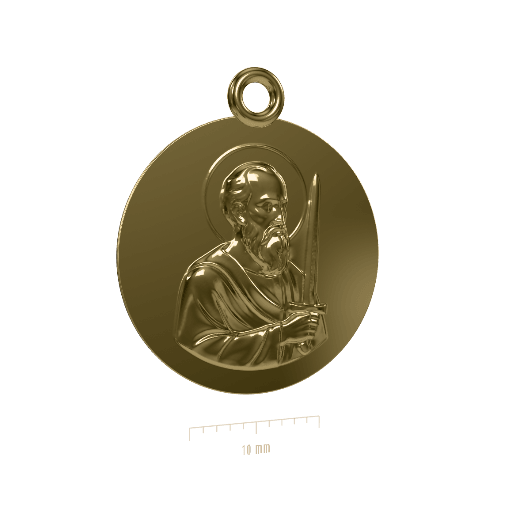
This medal of Saint Paul, the apostle from Tarsus, brings together the sword, the book, the scroll and the Damascus road—the symbols by which Christian tradition recognises him. It evokes a turning point: he who persecuted the disciples becomes a messenger of Christ. It is available in 750/1000 gold, 925/1000 silver and 925/1000 vermeil, for a christening, a communion, a confirmation or a personal milestone.
The back
The back can be engraved.
A name, a date, a few words: on the back of the medal, close to you.
The profile
1.1 mmThickness, relief included
- Diameter
- Ø 20 mm
- Overall height
- 23.4 mm
- Bail
- Round ring
The material
Choose your material.
Material
Your piece
Saint Paul Medal
Gold 750/1000
- Diameter
- 20 mm
- Approximate weight
- 2.8 g
€817
Optional — a name, a date. An engraved piece is made for you: it cannot be returned.0 / 40 · 2 lines at most
The piece, measured
Dimensions
- Shape
- Round
- Diameter
- 20 mm
- Overall height
- 23.4 mm
- Thickness, relief included
- 1.1 mm
- Bail
- Round ring
Approximate weight
- Gold 750/1000
- 2.8 g
- Silver 925/1000
- 1.9 g
- Vermeil 925/1000
- 1.9 g
Dimensions taken from the workshop model; weights estimated from its volume.
The piece and its story
What does the Damascus road tell us on the Saint Paul medal?
It tells of a change of direction. In the Acts of the Apostles (chapter 9), Saul travels to persecute the disciples of Jesus. On the road to Damascus, he encounters Christ. A disciple from the city, Ananias, is sent to him, and Saul soon begins to proclaim Jesus as Christ. Pope Benedict XVI returns to this episode in a homily: Paul falls to the ground, dazzled by light, then dedicates his life to Christ. It is the biblical account that grounds the Christian meaning of his conversion. Wearing this medal can become, for those who wish it, a reminder of a turning point in one's own life: a departure, a decision, a reconciliation. This interpretation belongs to whoever wears it. It is not imposed upon the jewel.23
What do the sword, book and scroll of Saint Paul mean?
The sword recalls, according to iconographic tradition, the weapon of his martyrdom. Vatican News reports his beheading in Rome and presents the joint martyrdom of Peter and Paul as traditional. The exact circumstances of his death therefore belong to tradition rather than to established historical fact. The book represents his writings: the National Gallery explains this in relation to a Saint Paul from the late 15th century, and the Prado shows the book and sword together in Rubens' Saint Paul. The scroll also appears in the iconographic repertoire of the apostle, as catalogued by the medieval iconography database at the Universidad Complutense de Madrid. These signs can be read together: a testimony to the end, a thought committed to writing, a word transmitted. The values of zeal, wisdom or perseverance that each person associates with them are a personal interpretation.4569
Why is Paul called the Apostle to the Nations?
Because his mission is addressed to those who were far from the Jewish world. Pope Benedict XVI, at the Angelus on 29 June 2008, designates him as the Apostle to the Nations, connects him to the city of Tarsus and emphasises the universal scope of Christian proclamation. Paul is therefore not merely a great traveller of the Mediterranean world: he opens faith to other peoples. This dimension gives particular meaning to a medal given to someone who seeks to transmit their convictions, to teach or to share their faith with those close to them who are different from them.17
Giving a Saint Paul medal: christening, communion, confirmation?
No occasion is reserved for this medal; what matters is the message you wish to convey. For a christening, it can welcome a beginning and wish the child a path of faith. For a communion or confirmation, it can accompany the deepening of that faith and the courage to express it. For an adult, it can mark a life change, a course of study, a commitment or the courage to persevere through a trial. To choose Paul is to choose a figure of turning point and mission. A short phrase slipped into the box, explaining the meaning you give to this choice, will make the gift more personal.
Gold, silver or vermeil: which material to choose?
The medal is available in 750/1000 gold, 925/1000 silver and 925/1000 vermeil. 750/1000 gold is suitable for a jewel intended to last and be passed down; its weight is estimated at 2.78 g. 925/1000 silver offers a lighter option, with an estimated weight of 1.87 g. Vermeil is 925/1000 silver coated with gold, to achieve the gold tone on a silver base. For a child, a material that is simple to wear daily is a practical choice. For a confirmation gift or a more lasting keepsake, gold may better mark the event. Store the medal away from other jewellery and wipe it with a soft cloth after wearing.
Your questions
- When is Saint Paul's feast day?
- Paul is celebrated on 29 June, together with Peter. The Church of Rome celebrates them together in a single solemnity, and Pope Benedict XVI designates them as the patron saints of Rome. This date may be a good time to give the medal.18
- Is Saint Paul the patron of anything?
- The patronage attested by Pope Benedict XVI is that of the city of Rome, which Paul shares with Peter.1
- How do you pray to Saint Paul?
- Here is an original, non-liturgical prayer: 'Saint Paul, you whose life witnesses to zeal, wisdom and perseverance, accompany those who change their lives and seek the courage to proclaim their convictions. Help us to keep hope in trial and to serve others with a free heart. Amen.'
References
- 1vatican.va · content/benedict-xvi/fr/an…_ben-xvi_ang_20080629.html
- 2aelf.org · bible/Ac/9
- 3vatican.va · content/benedict-xvi/fr/ho…vi_hom_20070628_vespri.pdf
- 4nationalgallery.org.uk · paintings/style-of-ambrogio-bergognone-saint-paul
- 5ucm.es · bdiconografiamedieval/san-pablo
- 6museodelprado.es · coleccion/obra-de-arte/san…d87-4bb2-adc1-266482f24875
- 7vatican.va · content/benedict-xvi/en/an…_ben-xvi_ang_20080629.html
- 8vatican.va · content/benedict-xvi/fr/ho…i_hom_20080629_pallio.html
- 9vaticannews.va · fr/saint-du-jour/06/29/sai…n-de-la-ville-de-rome.html
From the same family