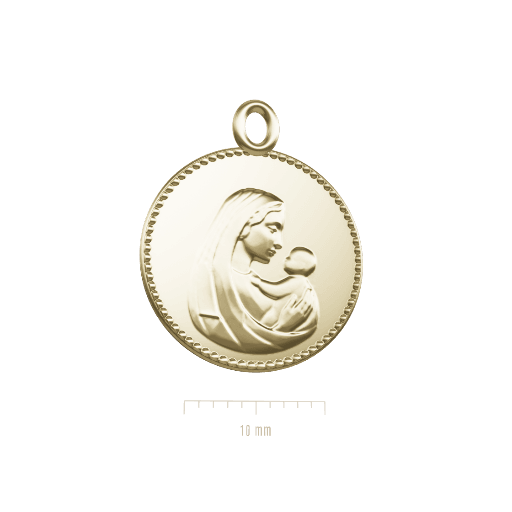
Medal of the Virgin Mary with Jesus
From€399
Choose your materialThe material
Choose your material.
Material
Your piece
Medal of the Virgin Mary with Jesus
Gold 750/1000
- Diameter
- 16.5 mm
- Approximate weight
- 3 g
€699
Optional — a name, a date. An engraved piece is made for you: it cannot be returned.0 / 40 · 2 lines at most
The piece, measured
Dimensions
- Shape
- Round
- Diameter
- 16.5 mm
- Overall height
- 20.1 mm
- Thickness, relief included
- 1.3 mm
- Bail
- Oval ring
Approximate weight
- Gold 750/1000
- 3 g
- Silver 925/1000
- 2 g
- Vermeil 925/1000
- 2 g
Dimensions taken from the workshop model; weights estimated from its volume.
The piece and its story
From Nazareth to consent: the Annunciation
Mary is first a young woman of Nazareth, in Galilee, betrothed to Joseph, according to the Gospel of Luke. The account of the Annunciation (Luke 1, 26-38) unfolds in stages: the angel Gabriel announces to her that she will bear a son named Jesus; Mary is troubled; she asks a question; then she consents. This progression gives concrete meaning to the words faith and availability: Mary does not agree without thought, she questions before consenting. At the Visitation, Elizabeth declares her blessed for believing in the fulfilment of the Lord's words (Luke 1, 45). Giving a medal of Mary with Jesus can be a way to evoke that moment when a free response opens a story. This reading remains a resonance offered by the narrative, not an intention attributed to all those who will wear the medal.2
Why depict Mary with Jesus?
Because Mary is understood first through her relationship to her son. In Christian art, the Virgin and Child is an ancient theme: the Louvre observes that statues of the Virgin carrying the Christ Child often emphasise the affective relationship between a mother and her young child. This observation illuminates the meaning of the motif: tenderness, protection, transmission of life from one to another. It helps explain why this image moves both a family celebrating a christening and a grandmother offering a keepsake to her granddaughter. This connection belongs to art history in general; the subject of this medal is simply Mary with Jesus.4
Cana and the Cross: a trust that shows itself
John's Gospel shows Mary in quiet action twice. At Cana (John 2, 1-11), she notices that the wine has run out, speaks to Jesus about it, then tells the servants to do whatever he tells them. John presents the water turned into wine as the beginning of Jesus's signs. In this we read an attention to the needs of others and trust placed in her son. Later, John 19, 25-27 places Jesus's mother at the Cross: Jesus entrusts to Mary the disciple he loves and entrusts her to that disciple, who welcomes her into his home. This can be heard as steadfastness in trial. This reading is a resonance of the text, which a person can make their own upon receiving the medal, without it being imposed.13
Who should receive this medal and in what material?
It suits a christening, communion or confirmation, but also a person named Mary or anyone with a devotion to the Virgin. Before choosing, express what you wish to convey: trust, hope, memory of a day. A note enclosed with the gift, citing for example the Annunciation or Cana, gives the medal a particular story. As for material, 18ct yellow gold addresses a piece intended to last and be passed down; 925 sterling silver is a sober option; 925 silver vermeil combines the appearance of gold with a silver base. Choose according to the jewellery the person already wears, so the medal naturally joins their chain or bracelet.
When is Mary celebrated in the Catholic calendar?
On 15 August, the Catholic calendar celebrates the Assumption: the Catholic Church teaches that at the end of her earthly life, Mary was taken up in body and soul to heavenly glory. This is a teaching of Catholic faith, not an episode recounted in the Gospels. This date can be chosen to give the medal to a person named Mary or to a family devoted to this feast.5
Your questions
- Does this medal depict a specific gesture of Mary towards Jesus?
- The motif is Mary with Jesus. Observations on the Virgin and Child, particularly those of the Louvre on the affective bond between a mother and her young child, illuminate the theme in general without describing a particular posture.4