Padre Pio Medal of Pietrelcina
From€299
Choose your materialThe face
Padre Pio Medal, saint of confession
This medal depicts Saint Padre Pio of Pietrelcina, a Capuchin friar and Italian priest. It addresses those who feel close to this saint, to his welcome at the confessional and his perseverance in prayer. It can become a personal reminder to pray or a gift for a loved one. It is offered in 750/1000 gold, 925/1000 silver and 925/1000 gold vermeil.
The back
The back can be engraved.
A name, a date, a few words: on the back of the medal, close to you.
The profile
1.2 mmThickness, relief included
- Diameter
- Ø 22 mm
- Overall height
- 25.7 mm
- Bail
- Round ring
The material
Choose your material.
Material
Your piece
Padre Pio Medal of Pietrelcina
Gold 750/1000
- Diameter
- 22 mm
- Approximate weight
- 3.5 g
€1,087
Optional — a name, a date. An engraved piece is made for you: it cannot be returned.0 / 40 · 2 lines at most
The piece, measured
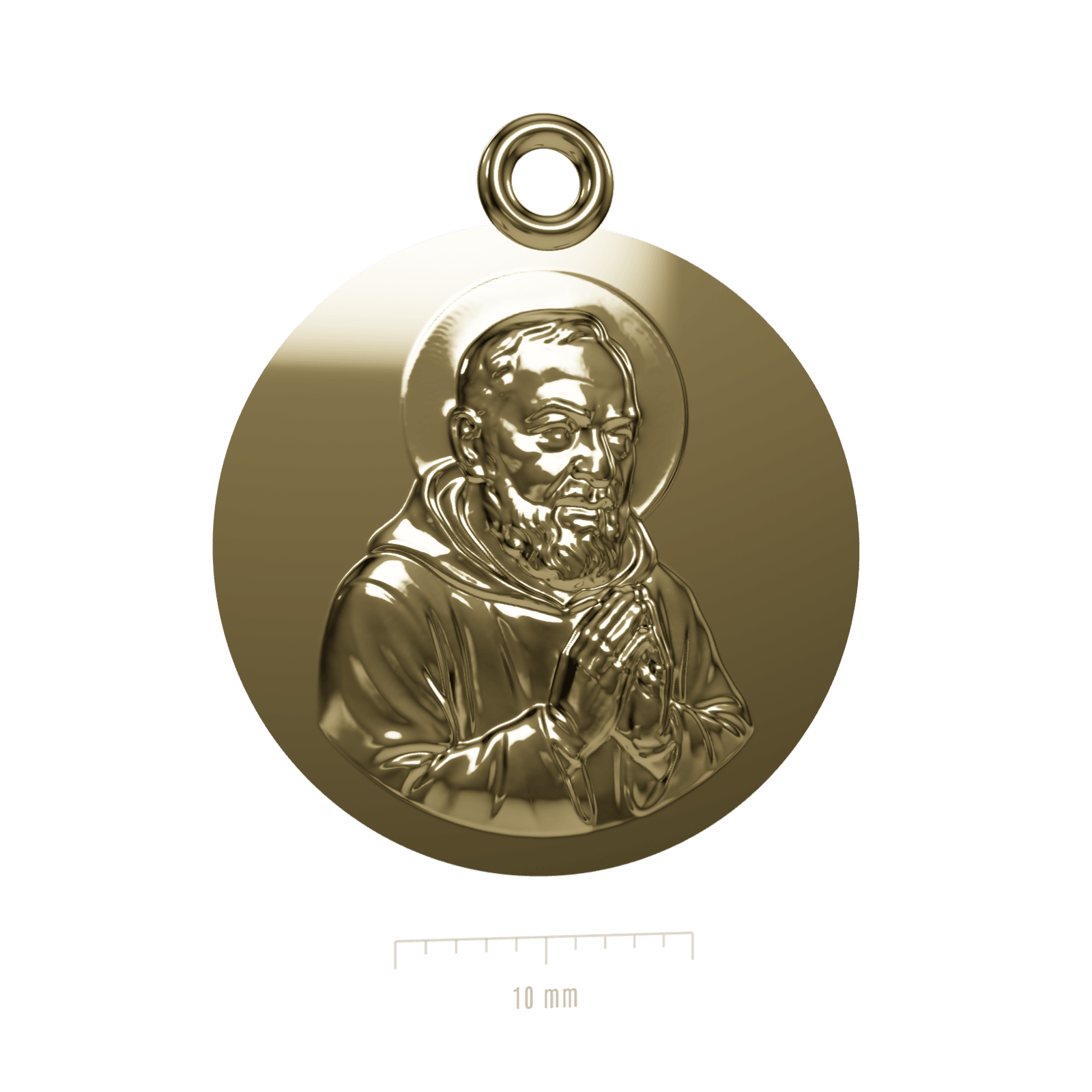
Dimensions
- Shape
- Round
- Diameter
- 22 mm
- Overall height
- 25.7 mm
- Thickness, relief included
- 1.2 mm
- Bail
- Round ring
Approximate weight
- Gold 750/1000
- 3.5 g
- Silver 925/1000
- 2.4 g
- Vermeil 925/1000
- 2.4 g
Dimensions taken from the workshop model; weights estimated from its volume.
The piece and its story
Who is Saint Padre Pio of Pietrelcina?
Padre Pio was a Capuchin friar and Italian priest, born Francesco Forgione on 25 May 1887 in Pietrelcina. He took the name Brother Pio among the Capuchins in 1903 and received priestly ordination on 10 August 1910. It is important to distinguish his birthplace, Pietrelcina, from the place of his ministry: sent in September 1916 to the convent of San Giovanni Rotondo, he remained there until his death on 23 September 1968. John Paul II proclaimed him a saint on 16 June 2002. The name Pietrelcina thus recalls the village where he was born.12
Why do the faithful turn to Padre Pio?
The faithful turn to him first for the welcome he extended to those who came to see him. In his canonisation homily, John Paul II emphasises three dimensions of his ministry: welcome, spiritual direction and the sacrament of penance. The confessional is thus the place where mercy takes on a concrete meaning: acknowledging a fault, entrusting it, then finding the peace of sacramental forgiveness. Spiritual guidance given with patience, attentive listening, a move towards reconciliation: this is what explains the closeness felt by many Catholics towards this saint. Choosing this medal rather than another Christian figure often means recognising oneself in this way of accompanying people.1
When should I pray to Padre Pio?
The closing prayer of the canonisation homily, spoken by John Paul II on 16 June 2002, gives specific intentions: to persevere in prayer, to recognise Christ in the poor and suffering people, to endure hardship and find the joy of sacramental forgiveness. One may therefore turn to Padre Pio in a difficult moment, when seeking reconciliation with God or a loved one, when prayer grows weary, or to become more attentive to others. These intentions are Catholic requests made to his intercession, not a guarantee of results. On a personal level, one may simply say: "Saint Padre Pio, help me to persevere in prayer and to remain attentive to those who suffer." This sentence is not an official prayer.1
Faith attentive to suffering: the Casa Sollievo della Sofferenza
Padre Pio did not confine himself to prayer: he founded the Casa Sollievo della Sofferenza, a hospital opened on 5 May 1956. His foundation addresses the concern to relieve the suffering and difficulties of families. In his homily, John Paul II links this charitable commitment to the prayer groups founded by Padre Pio, and thus presents prayer and charity as two related dimensions of his teaching. For the wearer of the medal, this episode gives concrete meaning to attention to suffering people: praying for them, but also, to the best of one's ability, being present to them.12
Wearing or giving this medal
The meaning given to this medal is a matter of personal choice, distinct from the religious references mentioned above. When worn, it can recall a journey of faith, a confession that mattered or the invitation to pray each day. When given, it can express attentive presence beside a loved one going through a difficult time, or mark shared admiration for this saint. It is available in 750/1000 gold, 925/1000 silver and 925/1000 gold vermeil, three materials that allow the gift to be adapted to the intended use. A simple gesture accompanies the gift well: add a few words about the reason for the choice.
Your questions
From the same family